
The New Era of Intelligent Production for Welding Robots
Release Time:
2024-12-05
As an important device in modern automated production, welding robots feature high efficiency, precision, and stability, aiming to improve production efficiency and product quality. This article will introduce the advantages and application scenarios of welding robots.
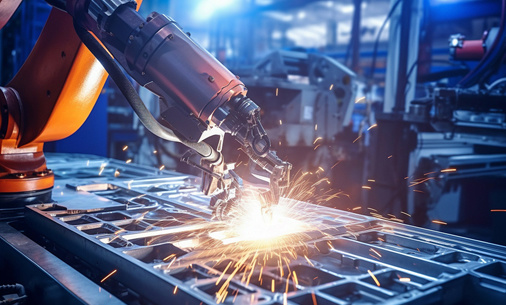
A welding robot is a specialized device that performs welding operations through an automated system, mainly composed of mechanical structures, sensors, control systems, and other components. Welding robots feature flexible robotic arms, precise movements, and stable operation, capable of replacing traditional manual welding to improve production efficiency and product quality.
In the manufacturing sector, welding robots are widely used in industries such as automobile manufacturing, aerospace, and electronic products. For example, in automobile manufacturing, welding robots can complete processes like body welding, spot welding, and assembly, enabling intelligent production lines that significantly shorten production cycles, reduce labor costs, and minimize resource waste.
Compared to traditional manual welding, welding robots offer higher welding precision, stability, and efficiency. Their control systems operate according to preset welding paths and force, avoiding quality instability caused by human factors. Additionally, the intelligent features of welding robots allow automatic adjustments based on the requirements of different workpieces, enhancing applicability and flexibility.
Overall, as an important part of modern automated production, welding robots will play an increasingly significant role in future manufacturing. Their efficient, precise, and stable characteristics not only improve production efficiency but also bring more possibilities and development opportunities to the manufacturing industry.